

Become the advisor your clients need when everything changes.
A fully online, self-paced professional certificate program.
Learn on your schedule. Earn 10 CFP® CE credits if eligible. Graduate with ongoing access to professional resources and quarterly ATW Graduate Forums.

Grief can affect attention, memory, confidence, decision-making, family relationships, and a client’s ability to process complex financial information. At the same time, widowed clients may face some of the most consequential financial decisions of their lives.
Advising Through Widowhood® prepares financial advisors and other professionals who serve clients through the financial consequences of spousal loss to navigate this extraordinary period with greater skill, judgment, confidence, and care.
This comprehensive professional certificate program goes beyond technical financial knowledge to examine the emotional, behavioral, practical, and ethical considerations involved in serving clients after the death of a spouse. It explores how grief can shape communication, trust, decision-making, financial vulnerability, and the pace at which advice is best delivered.
Why does widowhood require specialized advisory competency?
Widowhood is not simply another financial planning event.
The death of a spouse can disrupt nearly every part of a client’s life at once: income, household responsibilities, identity, family relationships, financial confidence, decision-making, and expectations for the future.
Yet financial advisors are often among the first professionals a widowed client turns to for guidance.
That creates an unusual professional responsibility.
A grieving client may be asked to make consequential decisions involving investments, Social Security, pensions, insurance, taxes, estate matters, housing, debt, beneficiaries, and long-term financial security—often while experiencing cognitive overload and profound emotional stress.
Traditional advisor education teaches professionals what financial decisions need to be addressed.
Advising Through Widowhood® adds another dimension: How should an advisor guide those decisions when the client is grieving?
You will learn when to move forward, when to slow down, which risks require immediate attention, which decisions can safely wait, and how the advisor’s role should evolve as the client moves from crisis toward greater stability, confidence, and independence.

What will I learn?

Advising Through Widowhood® is a comprehensive professional education program designed for professionals who serve widowed clients through financial transitions.
The program examines widowhood through the financial, behavioral, emotional, practical, and ethical lenses needed to serve these unique clients effectively.
Upon completion, participants will be able to:
Explain widowhood as a total-system crisis and understand how grief, cognitive overload, disrupted roles, and changing financial responsibilities can affect client behavior and decision-making.
Understand the demographic, economic, and professional significance of widowhood and why financial professionals are increasingly likely to serve clients navigating the death of a spouse.
Recognize how grief affects financial conversations, including memory, attention, confidence, information processing, and decision-making.
Identify appropriate priorities during the early stages of widowhood, distinguishing immediate financial needs from decisions that can safely wait.
Adapt communication and planning techniques to better serve clients experiencing grief, uncertainty, and cognitive overload.
Recognize common financial vulnerabilities including experience and knowledge gaps, family or professional pressure, and potentially irreversible decisions—and apply appropriate protective strategies.
Navigate family dynamics, professional collaboration, and ethical boundaries that frequently arise after the death of a spouse.
Help clients transition from financial crisis toward long-term planning, confidence, independence, and renewed financial direction.
The result is a better framework for practicing financial advice during one of the most consequential transitions your clients may ever experience.
Technical expertise matters. But during widowhood, how advice is delivered can be just as important as the advice itself.
Advising Through Widowhood® helps professionals develop the judgment to recognize what a grieving client may need at different stages of the widowhood journey.
You will become better prepared to:
Slow the decision-making process when necessary.
Not every financial decision is urgent simply because it appears important.
Communicate more effectively with grieving clients.
Learn how cognitive overload and grief can affect conversations, comprehension, memory, and follow-through.
Recognize risks that traditional planning may overlook.
Financial vulnerability after loss can involve far more than investment risk.
Build deeper client trust.
Clients remember the professionals who helped them navigate the moments when they felt least certain.
Work more effectively with family members and other
professionals.
Widowhood often requires coordinated guidance rather than isolated financial advice.
Know the boundaries of your role.
Serving grieving clients well requires both compassion and professional discipline.
Guide clients from crisis to confidence.
The advisor’s role changes as the widowed client becomes increasingly capable of looking beyond immediate problems and toward the future.
Ultimately, Advising Through Widowhood® helps you become not simply a financial expert, but a more thoughtful, capable, human-centered advisor.


What do I receive when I complete the program?

Advising Through Widowhood® Certificate
The certificate recognizes successful completion of specialized professional education focused on serving clients following the death of a spouse.

Earn CFP® Continuing Education Credit
CFP® professionals are eligible to receive 10 hours of CFP Board continuing education credit upon completion of the program.
The program is open to financial advisors and other professionals whose work may involve financial, tax, legal, insurance, estate, or wealth-management considerations following the death of a spouse.

The Widowed Guide to Financial Wellness
Every ATW participant receives the digital edition of The Widowed Guide to Financial Wellness, 3rd Edition as a companion reference to the program.
The guide provides detailed financial guidance, practical checklists, planning considerations, and technical reference material covering many of the financial issues that can arise following the death of a spouse.
Prefer a printed copy? The physical edition is client-friendly and available separately on Amazon for $49.
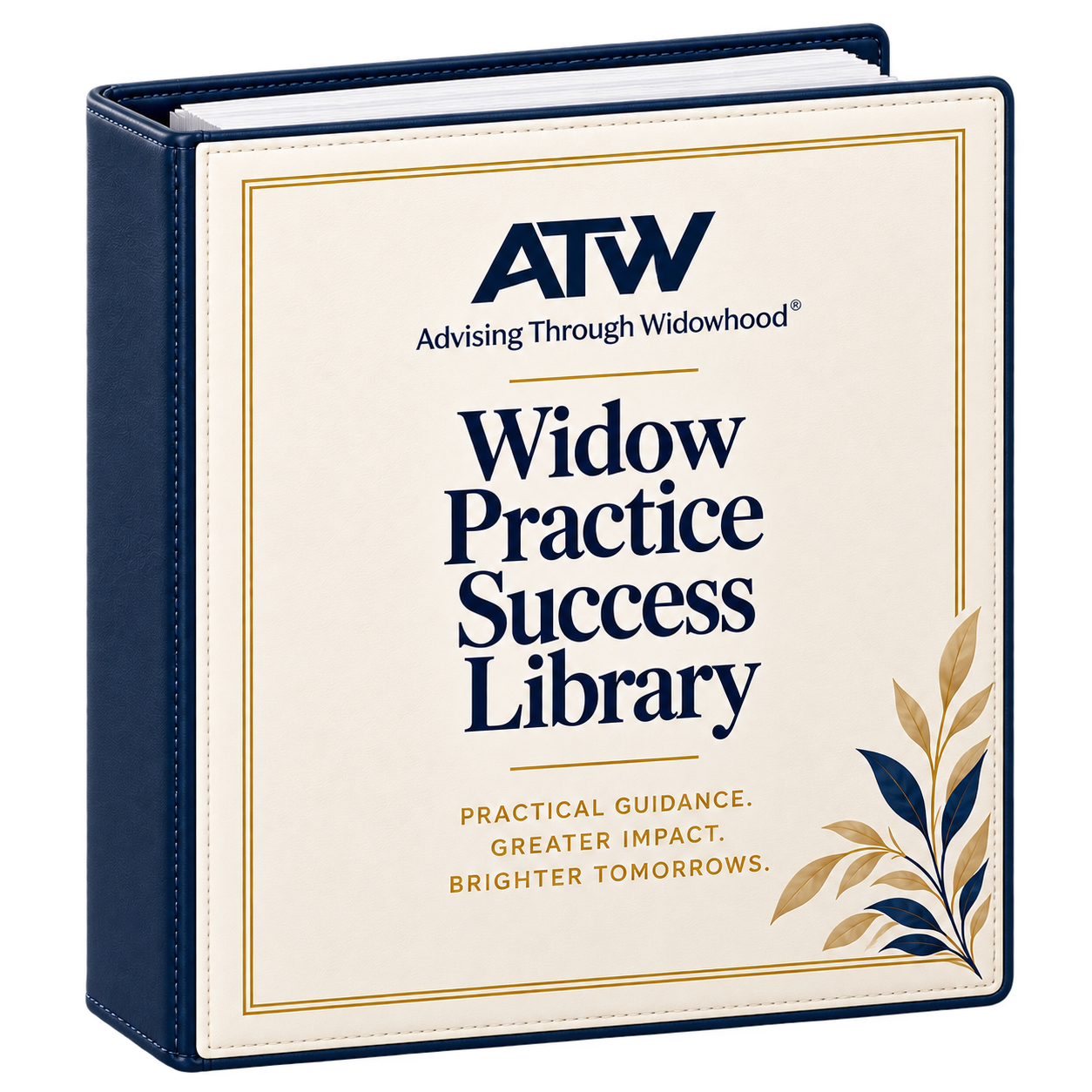
Widow Practice Success Library
Graduates receive ongoing access to the growing Widow Practice Success Library, an eight-guide professional resource collection designed to help translate ATW principles into everyday practice.
The library includes practical frameworks, conversation guidance, checklists, practice-development tools, and other resources developed specifically for professionals serving widowed clients.
New guides and resources will be added as the library continues to expand.

Quarterly ATW Graduate Forums
Graduates receive ongoing access to quarterly live virtual forums exclusively for the ATW graduate community.
Forums will feature expert panels, case discussions, emerging issues, practical applications, and professional Q&A—providing an opportunity to continue learning from specialists and explore how ATW principles apply to real-world situations.
The Graduate Forums extend ATW beyond the initial certificate program, helping professionals deepen their knowledge and stay connected to evolving best practices in widowhood advising.

Put Your Learning Into Practice
Graduates may also have the opportunity to volunteer with Wings for Widows, a nonprofit organization providing no-cost financial coaching to widowed people.
For professionals who want to deepen their experience while serving others, volunteering can provide a meaningful opportunity to apply ATW principles in real-world client situations.
Completion of Advising Through Widowhood® does not guarantee acceptance as a Wings for Widows volunteer coach; separate eligibility and onboarding requirements apply.
